
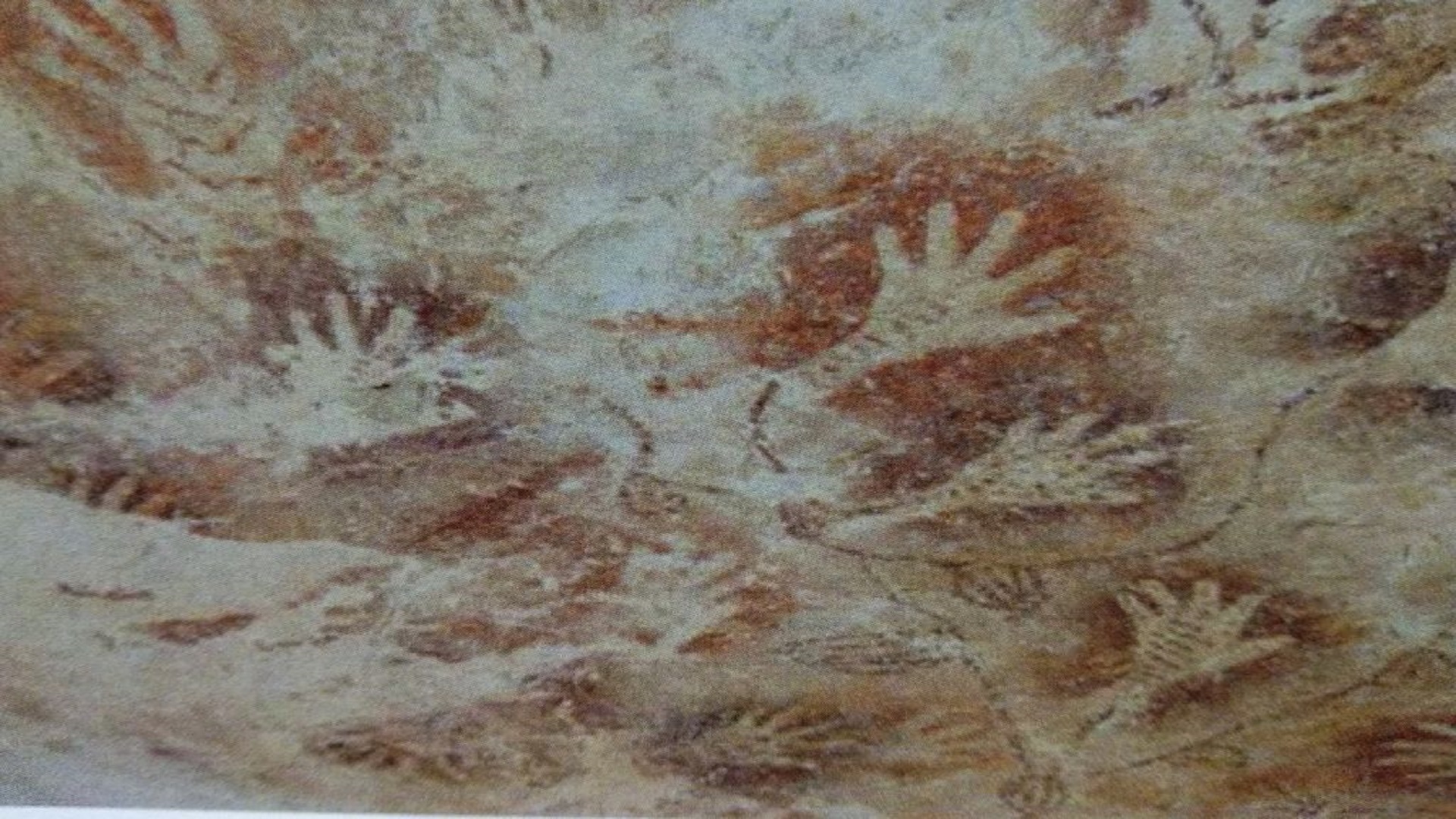
♦ The painted outline of a human hand inside a cave on the Indonesian island of Muna represents what researchers are calling the oldest example of rock art in the world, created at least 67,800 years ago. The reddish-colored stenciled image has become faded over time and is barely visible on a cave wall, but nonetheless embodies an early achievement of human creativity as our species spread worldwide after arising in Africa. The people responsible for this rock art, the researchers said, were part of a population that made its way from mainland Asia to the islands of Indonesia, and later may have continued on to Australia.
♦ The hand stencil was discovered in a limestone cave called Liang Metanduno on Muna, a satellite island off the southeastern peninsula of the large island of Sulawesi east of Borneo. The researchers determined the minimum age of the image by analyzing small amounts of the element uranium in mineral layers that gradually formed atop the pigment.
♦ The hand stencil is older than a cave painting depicting three human-like figures interacting with a pig dated to at least 51,200 years ago at the Leang Karampuang site in southwestern Sulawesi. It also is older than rock art in the form of a hand stencil at Maltravieso in Spain that dates to around 64,000 years ago and has been attributed to Neanderthals.
♦ While the newly described image was barely discernible, the researchers found nearly identical images in much better shape elsewhere in the area, showing that this design was not a one-time creation. In earlier research in Sulawesi, the researchers also documented images of human figures with animal features, dated to at least 48,000 years ago.