
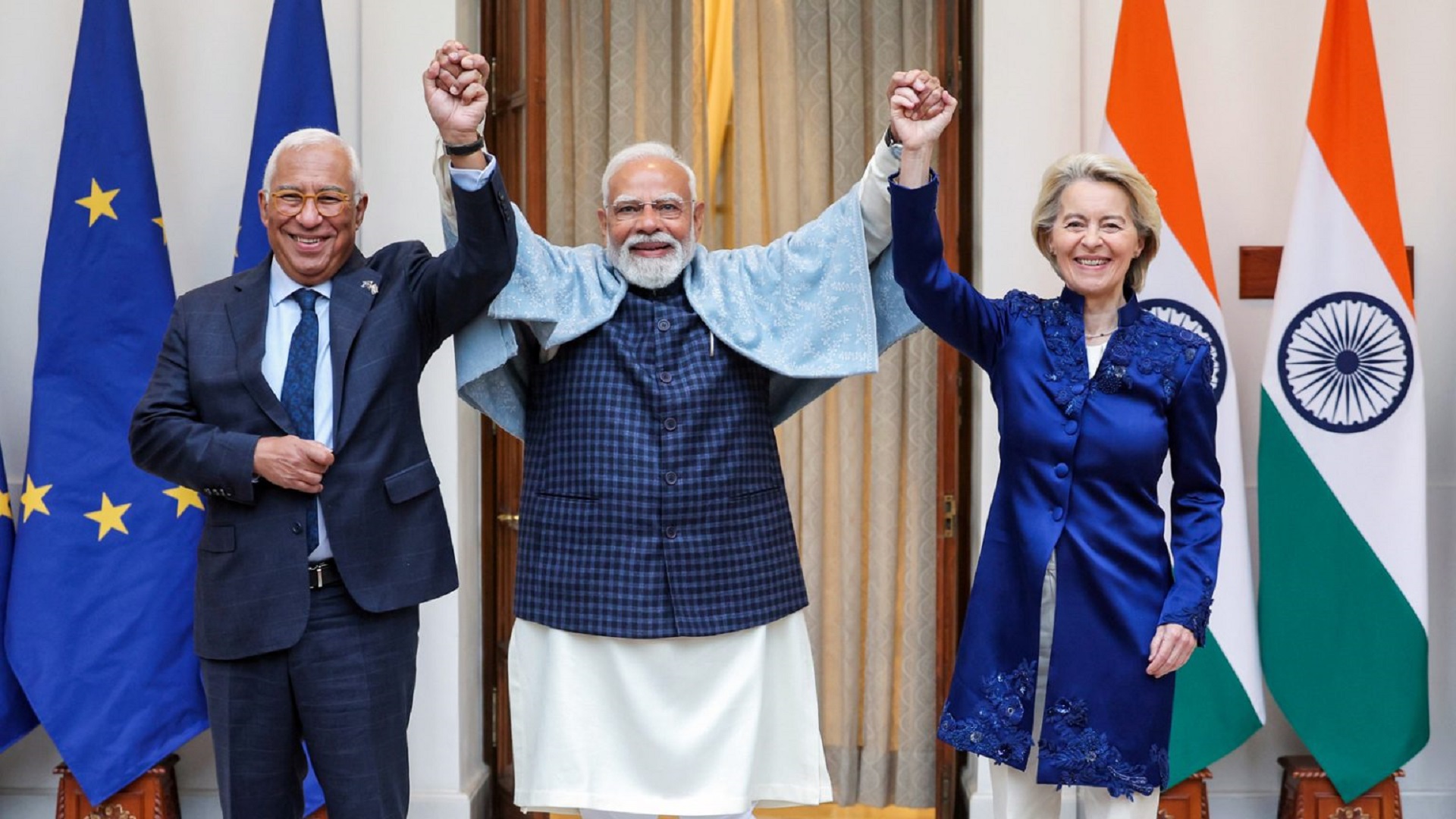
♦ India and the European Union on 27 January 2026 announced the conclusion of the long-awaited India-EU Free Trade Agreement (FTA), described as the “Mother of All Deals”. This marking a historic milestone in bilateral relations between two of the world’s largest economies. The announcement was made at the 16th India-EU Summit by Prime Minister Narendra Modi and European Commission President Ursula von der Leyen during the visit of European leaders to India.
♦ Covering two of the world’s largest economies – the 4th and 2nd globally – the India-EU FTA creates a combined market of over USD 24 trillion (around INR 2,091.6 lakh crore), unlocking vast opportunities for nearly two billion people. Designed as a modern, rules-based trade framework, the agreement responds to contemporary global challenges while enabling deeper market integration, resilient supply chains, and long-term economic cooperation.
♦ The FTA delivers unprecedented market access for Indian exports, with preferential access across 97% of EU tariff lines, covering 99.5% of India’s export value. Crucially, over 70% of tariff lines – representing more than 90% of India’s exports – will see immediate duty elimination, benefiting labour-intensive sectors such as textiles, apparel, leather, footwear, marine products, gems and jewellery, toys, sports goods, tea, coffee, and spices.
♦ These sectors, currently facing EU import duties ranging from 4% to 26%, are central to employment generation and MSME growth in India. With zero-duty access from the FTA’s entry into force, Indian exporters are expected to gain enhanced competitiveness, deeper integration into European value chains, and greater certainty in long-term investment planning.
♦ On the other side, India has offered market access across 92.1% of its tariff lines, covering 97.5% of EU exports. This includes immediate duty elimination on nearly half of tariff lines and phased liberalisation over 5, 7, and 10 years on others. Enhanced access for high-technology European goods is expected to diversify India’s import sources, reduce input costs, and support domestic manufacturing and global value chain integration.