
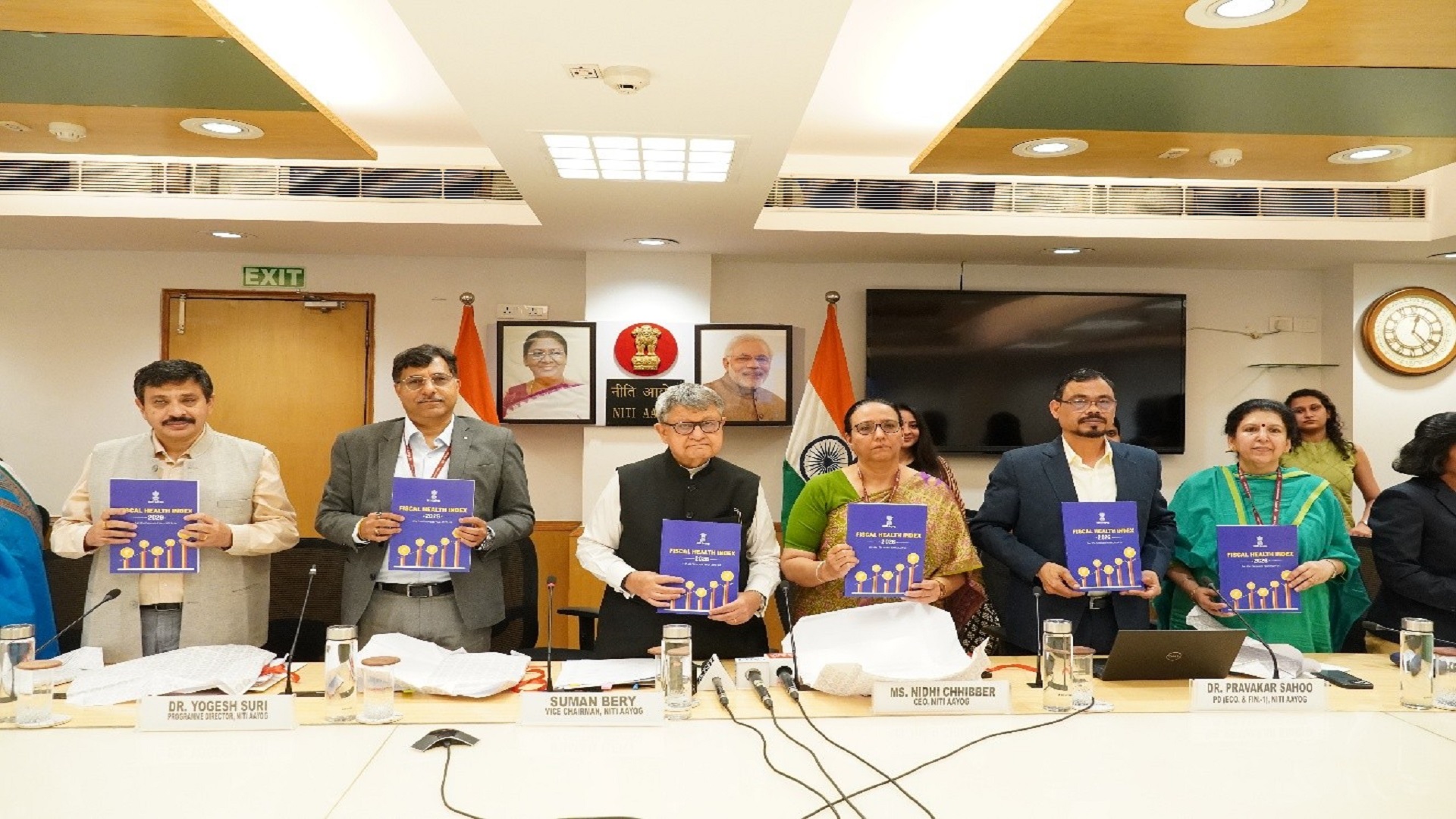
♦ NITI Aayog released the second annual edition of the Fiscal Health Index 2026 in New Delhi on 11 March 2026. The report highlights several policy priorities for strengthening fiscal health across states. These include enhancing revenue mobilisation and strengthening state-owned tax capacity, rationalising committed expenditures to restore fiscal flexibility, improving the composition and quality of capital expenditure.
♦ The Fiscal Health Index 2026 provides an important resource for policymakers, researchers, and stakeholders by offering a transparent and data-driven assessment of state finances.
♦ Fiscal outcomes across the 18 major states vary, with some states states seeing moderated FHI scores in 2023-24 compared to 2022-23.
Highlights:
♦ The Achiever group (Odisha, Goa and Jharkhand) is characterised by high own-tax shares (above 60%), relatively large capital outlay (around 4–5% of GSDP), low fiscal deficits (below 3% of GSDP), moderate debt levels (under 25% of GSDP) and contained interest burdens.
♦ Front-Runner states (Gujarat, Maharashtra, Chhattisgarh, Telangana, Uttar Pradesh and Karnataka) and Performer states (Madhya Pradesh, Haryana, Bihar, Tamil Nadu and Rajasthan) broadly maintain their positions with minor reshuffling, though their scores moderate slightly compared to the previous year.
♦ Aspirational states (West Bengal, Kerala, Andhra Pradesh and Punjab) face persistent revenue and fiscal deficits often breaching FRBM norms, elevated debt levels of roughly 35–45% of GSDP, committed expenditure accounting for about 50–60% of revenue receipts, large interest payments exceeding 15–20%, and relatively low developmental spending.